

Master Key Systems vs Traditional Keys: Practical Benefits, Security & Key Management for Businesses
Master key systems and single-key (traditional) locks both control physical access, but they do it very differently. This guide explains what a master key system is, how it operates versus conventional keys, and why businesses choose one approach over the other based on scale, security needs and administrative effort. You’ll get a clear look at hierarchical pinning and keyways, practical steps for installation and upkeep, and key management strategies that improve traceability and reduce downtime. We also cover decision criteria, cost considerations and ROI so facilities managers and site decision‑makers can plan next steps with confidence.
What Are the Key Differences Between Master Key Systems and Traditional Locks?
A master key system uses a layered key hierarchy: one master key can open many locks while subordinate (change) keys open only assigned doors. Traditional locks usually use a single change key per cylinder for one-to-one access. Master systems rely on pinning combinations and groups of keyed‑alike or keyed‑different cylinders to scale permissions, which reduces the number of keys in circulation and lets you enforce tiered access. For businesses this improves flexibility and speeds emergency response, but it also means planning, restricted blanks and solid key‑control policies are essential to maintain security. Understanding these structural and operational differences makes it easier to choose the right solution for your facility.
How Does a Master Key System Work Compared to Traditional Keys?
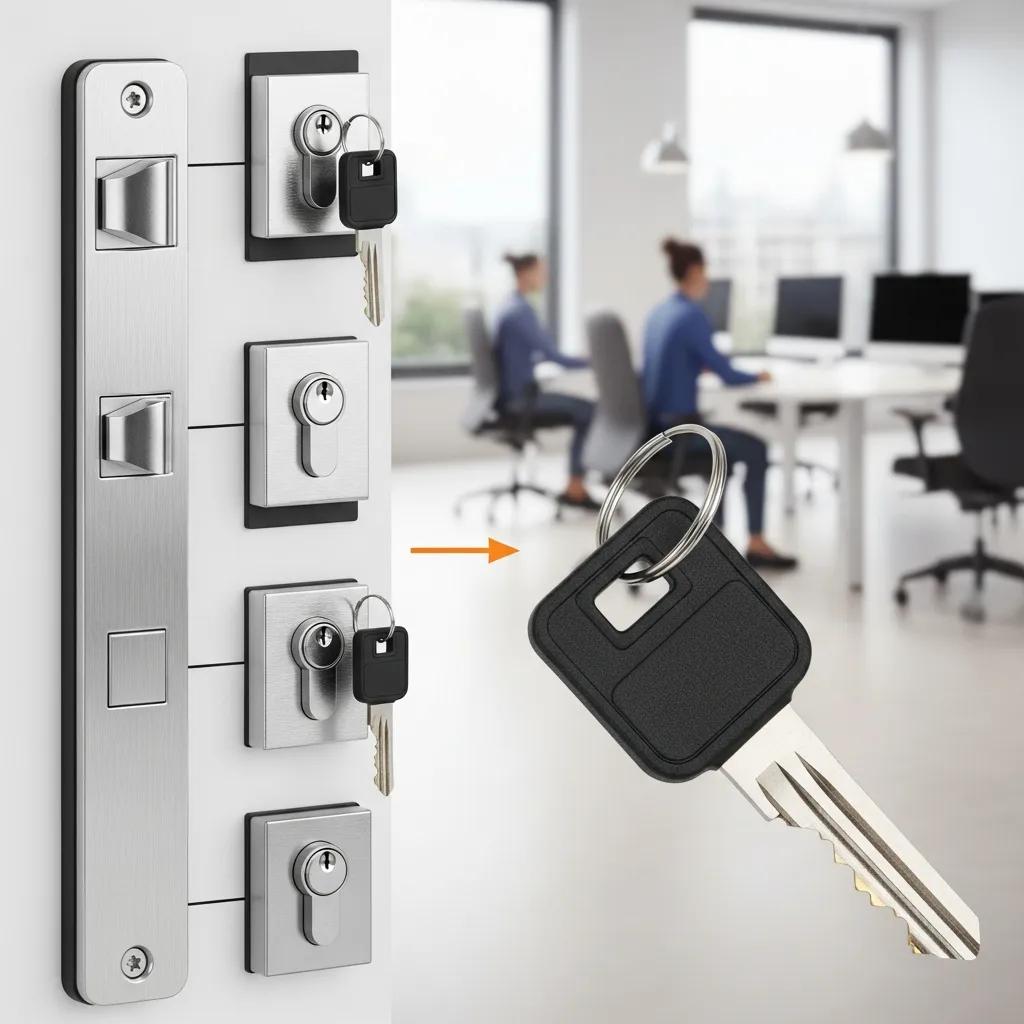
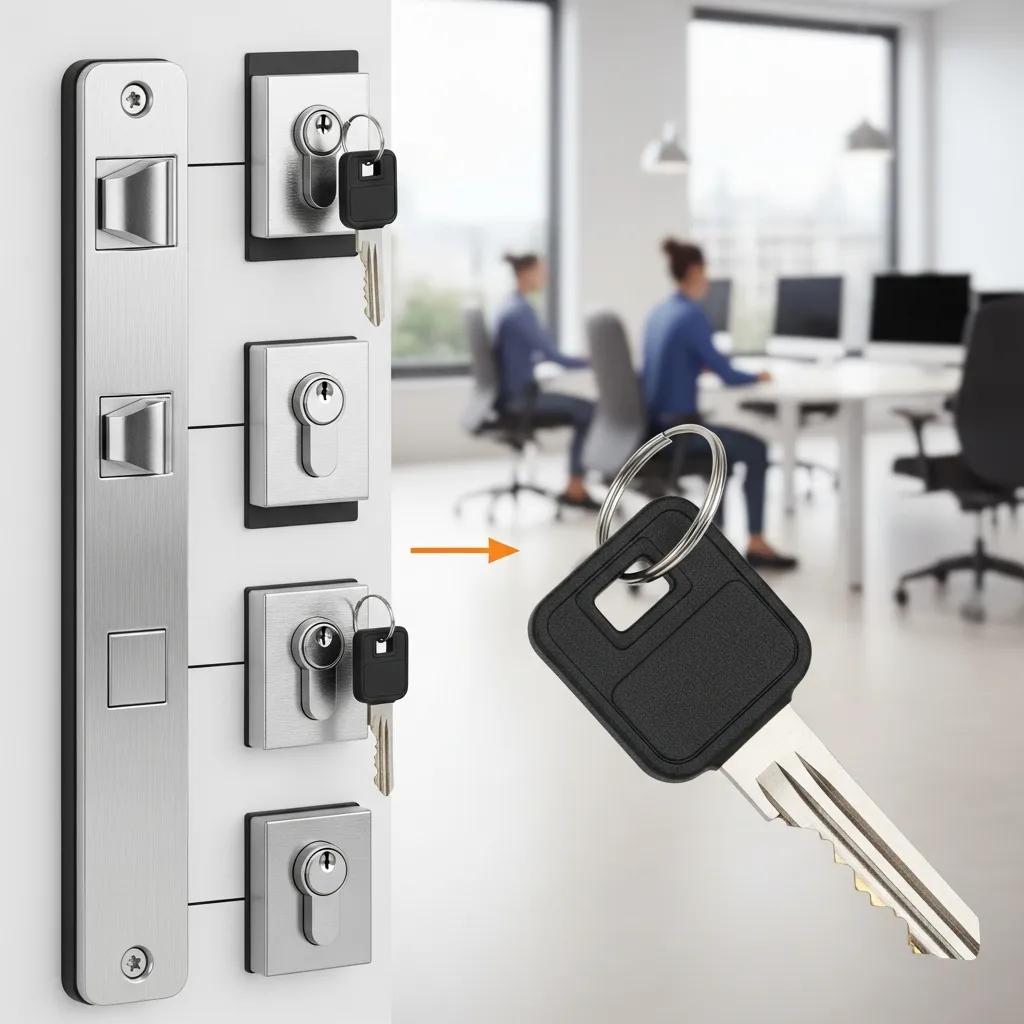
A master key system arranges cylinder pins and key cuts so specific shear lines match multiple keys: one cut pattern might open several locks while other cuts only open an individual cylinder. In an office example, staff carry sub‑keys for their rooms and service areas, managers hold floor master keys, and a grand master key can open the entire site when required. This pinning and hierarchy lets you map access precisely and supports roles such as change key (sub), master key and grand master key within a single scheme. The table below summarizes common key roles and the areas they typically cover.
| Key Role | Typical Access Level | Common Use |
|---|---|---|
| Grand Master Key | Building‑wide access | Senior management, facilities lead |
| Master Key | Zone or floor access | Department heads, security staff |
| Change/Sub-Key | Single‑room access | Individual employees, secure rooms |
That hierarchy simplifies key distribution but increases the need for disciplined key control and documentation.
What Are the Common Types of Traditional Locks Used in Businesses?
Common commercial lock types include cylindrical (cylinder) locks, mortise locks, deadbolts and padlocks — each serves a specific purpose. Cylinder locks are widespread on interior doors and can be integrated into master systems; mortise locks are heavier duty and common on exterior or high‑traffic doors. Deadbolts and padlocks secure storage rooms, gates or utility closets but become costly and disruptive to rekey when many locks must be changed. Because traditional keys are often managed individually, rekeying cost and downtime tend to climb quickly compared with a planned master‑keyed design.
What Are the Main Benefits of Master Key Systems for Businesses?

Master key systems simplify operations, improve emergency access and centralize control — all of which reduce the administrative load compared to many traditional setups. A clear key hierarchy lowers the total number of keys, speeds response during lockouts or incidents, and supports better auditing when paired with issuance policies or electronic logging. These advantages mean less downtime, fewer full‑system rekeys and better alignment with security governance. Below are the core benefits and a quick comparison with traditional keys.
Top benefits of a master key system:
- Management efficiency: Fewer keys to issue, track and replace, which reduces administrative work.
- Faster emergency access: Designated master keys shorten response time during critical events.
- Improved security controls: Restricted blanks and controlled duplication limit unauthorized copies.
- Lower long‑term costs: Less need to rekey large numbers of cylinders after turnover or loss.
These improvements support business continuity and let facilities teams focus on preventive work instead of repetitive corrective tasks.
| Management Metric | Master Key System | Traditional Keys |
|---|---|---|
| Number of physical keys | Reduced through hierarchical grouping | Grows with each new lock |
| Rekeying complexity | Localized by level; selective rekeying possible | Often requires rekeying many cylinders |
| Administrative auditability | Stronger with key logs and restricted blanks | Often manual and error‑prone |
The table shows how master key systems typically cut key counts, simplify rekey decisions and improve accountability versus traditional arrangements.
For Montreal businesses or similar urban sites considering master keying, talk with a local commercial locksmith to review your building and schedule a short on‑site survey. That survey identifies which doors, departments and emergency routes should be included in the hierarchy before ordering cylinders or restricted blanks.
How Do Master Key Systems Improve Business Key Management?
Master key systems make issuance and tracking more predictable by standardizing who gets which key level and how keys are logged and returned. Effective policies spell out roles eligible for master keys, require sign‑out procedures and mandate periodic audits. Physical key cabinets with tamper‑evident tags or electronic logging add accountability. Tools such as restricted blanks and labeled key maps that document key‑to‑door relationships reduce lost‑key incidents and speed corrective actions, and they integrate smoothly with onboarding and offboarding processes.
What Security Advantages Do Master Key Systems Offer Over Traditional Keys?
Key security benefits include controlled duplication through patented keyways, the ability to revoke or reassign access at specific hierarchy levels, and optional integration with electronic access control to capture audit trails. Restricted blanks and key registration deter casual copying; hierarchy enforces least privilege by limiting who can access sensitive areas. When a key is lost, you can rekey individual cylinders or affected levels depending on exposure — usually faster and less costly than rekeying every door in an undocumented traditional setup. Those controls shrink the window of vulnerability during staff turnover or incidents.
How Is a Commercial Master Key System Installed and Maintained?

Installing a commercial master key system follows clear phases: survey, design, procurement of restricted blanks and cylinders, installation, testing and documentation handover — followed by routine maintenance and audits. Typically, a certified locksmith handles pinning and installation while the facility manager provides access maps and signs off on hierarchy levels. Proper installation includes labeling cylinders, producing master and change keys with traceability, and delivering a keyed‑plan document that lists key codes and access rights. Ongoing maintenance includes scheduled audits, fast response to lost keys and periodic reviews when teams reorganize.
Planning and procurement are critical and are scheduled by building size and complexity. The checklist below outlines the typical process and expected timeframes.
- Site survey and access mapping: Record doors, required access levels and constraints; typically 1–3 days depending on building size.
- System design and pinning chart creation: Develop the hierarchical plan and key schedules; usually 2–5 business days.
- Order restricted blanks and compatible cylinders: Lead times depend on manufacturer; plan for multiple weeks with patented keyways.
- Physical installation and testing: Replace or re‑pin cylinders, label keys and run staged tests; expect 1–7 days on site.
After the work, insist on a delivered keyed plan and clearly labeled keys to avoid ambiguity. The table below summarizes phases and typical responsibilities for budgeting and scheduling.
| Phase | Task | Typical Outcome |
|---|---|---|
| Survey | Map doors and access needs | Accurate key schedule |
| Design | Pinning chart and hierarchy | Clear master/sub relationships |
| Installation | Cylinder installation and testing | Labeled keys and verified access |
| Maintenance | Scheduled audits and rekey triggers | Sustained key control and records |
Routine maintenance should include quarterly or annual audits, immediate rekeying when keys are lost, and cylinder replacement when a breach is suspected. For installation or ongoing service, local Montreal commercial locksmiths can provide surveys, scheduled service plans and rapid emergency rekeying.
What Are the Steps Involved in Commercial Master Key System Installation?
Start with a full site survey that catalogs each door, lock type and required access level — this becomes the basis for your pinning chart and master key hierarchy. The design phase assigns key groups (sub‑master, master, grand master) and selects cylinders and restricted blanks to control duplication. Procurement logs restricted blanks and cylinders that match the chosen patents or manufacturer specs; lead times can affect the schedule. The on‑site phase installs hardware, verifies access for each key type, secures client sign‑off and hands over documentation including a keyed plan and key inventory.
How Do Businesses Maintain and Update Master Key Systems?
Maintenance centers on scheduled audits, quick action on lost or stolen keys and clear procedures for staff changes that affect access. Best practices include quarterly checks of key logs and cabinet inventories, immediate rekeying or cylinder replacement if a master‑level key is compromised, and annual reviews to align the keyed plan with organizational changes. Decision rules should define when to rekey (lost key with unknown exposure) versus when to replace a cylinder (suspected tampering or high‑risk breach), balancing cost and security. Keeping documentation current and enforcing sign‑in/out for master keys reduces downtime and supports incident reviews.
How Do Master Key Systems Enhance Security for Business Premises?
Master key systems strengthen security by enabling tiered access control, enforcing restricted duplication and supporting emergency override procedures without disrupting daily operations. Layered access limits exposure by role — for example, cleaning crews, inventory staff and executives each get appropriate access — while master keys maintain managerial oversight. When combined with electronic access control or CCTV, a master key system becomes part of a hybrid security approach that adds auditability and event correlation, reducing unauthorized movement and easing the administrative load of restoring secure access after incidents.
What Are the Specific Security Features of Master Key Systems?
Core security features include patented keyways and restricted key blanks that require authorized dealers for copies, hierarchical pinning that enforces role‑based access, and compatibility with high‑security cylinders offering anti‑drill and anti‑bump protections. Patented blanks are a form of restricted key control that deters unauthorized duplication, while pinning determines which key cuts operate which cylinders. Hybrid systems that combine physical master keying with electronic access controls add audit trails and scheduled access. Together, these features reduce the chance of undetected key copying and unauthorized entry.
How Do Master Key Systems Prevent Unauthorized Access Compared to Traditional Keys?
Master key systems reduce unauthorized access through controlled distribution, quick revocation options and limits on duplication. Traditional keys often allow uncontrolled copying and broad circulation. In a common scenario — a lost employee key — a master system lets you identify exposed zones and rekey only the affected levels, minimizing disruption and cost. Policies such as mandatory key return on termination and documented sign‑out processes close the accountability loop. Compared with one‑key‑per‑lock setups that may require mass rekeying after a compromise, master systems allow a more surgical and faster response.
What Are the Best Business Key Management Solutions Using Master Key Systems?
The right key management solution depends on your size and complexity: manual ledgers, electronic logging systems, third‑party managed key services or hybrids that mix physical master keying with electronic audit trails. Manual ledgers are low‑cost but don’t scale; electronic key management improves auditability and can integrate with HR systems; third‑party services shift ongoing responsibility and often include regular audits and emergency rekeying. Choose by weighing cost, scalability and audit requirements — the table below compares common approaches on those attributes.
Key management options to consider:
- Manual ledger and labeled key cabinets — suitable for small sites with limited staff.
- Electronic logging systems with tamper‑evident cabinets — a good fit for mid‑size organizations.
- Third‑party managed key services — ideal for larger operations that prefer outsourced maintenance, scheduled audits and fast emergency response.
Each option has trade‑offs in capital expense, day‑to‑day overhead and forensic readiness; the right mix depends on your priorities.
| Solution Type | Cost Profile | Auditability / Scalability |
|---|---|---|
| manual ledger | Low upfront, higher admin | Low auditability, poor scaling |
| Electronic logging | Moderate upfront, lower admin | High auditability, scalable |
| Third-party managed | Ongoing service fees | High reliability, outsourced scaling |
After selecting a model, document policies for issuance, revocation and contractor access, and schedule regular reviews. If you’d like a tailored key management plan that balances scalability with ROI, contact a Montreal commercial locksmith or local information hub to map a phased implementation that matches your budget and security goals.
How Can Businesses Customize Master Key Systems for Different Access Levels?
Customizing a master key system starts by mapping roles to access tiers — for example, department master keys, floor masters and time‑limited contractor keys — and capturing that in a pinning chart and labeled key inventory. Common templates use department or function (finance, IT, facilities) as the primary axis and assign sub‑keys for individual rooms while masters cover broader zones. Contractors can receive temporary keys or cylinders that are rekeyed after a project. Clear labeling, handover procedures and periodic role‑based reviews keep customizations aligned with changing needs.
What Are the Cost and Efficiency Benefits of Master Key Systems in Key Management?
Master key systems lower direct costs like labor for rekeying and indirect costs such as downtime from lockouts, because selective rekeying and restricted duplication reduce the need for wholesale cylinder replacement. Efficiency gains include fewer lockouts, faster emergency entry by authorized personnel and less administrative time tracking many individual keys. For example, a mid‑size facility that shifts from mass rekeys to selective level rekeys can recoup design and restricted blank costs within a few rekey cycles. Added benefits include smoother operations and a stronger compliance posture, which help justify the investment.
When Should Businesses Choose Master Key Systems Over Traditional Keys?
Choose a master key system when you have many doors, frequent staff changes or security needs that require tiered access and documented control. Typical triggers include multi‑floor offices, multi‑tenant buildings, healthcare clinics and retail operations with centralized oversight. Use the checklist below to evaluate scale, complexity and security posture. When a facility has dozens of locks and multiple administrative roles, master keying usually delivers better ROI and risk reduction than maintaining many independent traditional locks.
Checklist for choosing master keying:
- Number of doors makes individual keying burdensome.
- Regular staff changes or contractors increase risk of lost or copied keys.
- Business needs tiered access (inventories, records rooms, executive areas).
- Desire for documented control, faster emergency response and lower long‑term rekey costs.
If several checklist items apply, a master key system will likely provide operational and security advantages.
What Business Sizes and Types Benefit Most from Master Key Systems?
Sectors that benefit most include multi‑tenant office buildings, hotels, healthcare clinics, schools and retail chains where many doors and role‑based access complicate traditional key management. Small businesses with only a few doors can often use keyed‑alike cylinders or basic key control; medium and large organizations typically see clearer savings from centralized key hierarchies. In every sector the logic is the same: as scale and access complexity increase, hierarchical control becomes more efficient and secure than ad‑hoc key proliferation.
How Do Master Key Systems Support Business Growth and Security Needs?
Master key systems support growth by letting you add doors and roles into an existing hierarchy without reworking the whole locking infrastructure, and by enabling phased upgrades to higher‑security cylinders or electronic access as budgets allow. Designing for future expansion — reserving key groups and leaving room in the pinning chart — reduces later rework and cost. Hybrid approaches that combine physical master keying with electronic audit trails provide a migration path toward timed or remote access, ensuring your security architecture scales with the business.
Frequently Asked Questions
What are the initial costs associated with implementing a master key system?
Initial costs vary with facility size and locking complexity. Typical expenses include restricted key blanks, compatible cylinders and installation labor, plus any site survey or audit fees. Upfront investment can be higher than simple traditional locks, but long‑term savings from fewer rekeys and reduced administrative overhead often justify the cost.
How can businesses ensure the security of their master key systems?
Secure a master key system with strict key control policies: limit access to master keys, run regular audits of key logs, and use tamper‑evident cabinets. Patented keyways and restricted blanks prevent casual duplication. Train staff to report lost or stolen keys immediately and combine physical controls with electronic access where needed for extra visibility.
What should businesses do if a master key is lost or stolen?
Act quickly: assess which areas the lost key could access, then decide whether to rekey affected cylinders or rekey whole levels depending on exposure. Document the incident, update key logs and review control policies to prevent repeats. Fast, documented responses are critical to limiting risk.
Can master key systems be integrated with electronic access control systems?
Yes. Hybrid setups let you keep a physical master hierarchy while adding electronic controls for real‑time monitoring, audit trails and remote capabilities. This combination simplifies management, strengthens oversight and allows more flexible responses to changing access needs.
What are the best practices for maintaining a master key system?
Best practices include scheduled audits of key logs and inventories, immediate rekeying if a key is lost or compromised, and clear procedures for issuing and returning keys during staff changes. Periodic reviews of access levels and documented sign‑out processes help keep the system aligned with current operations.
How do master key systems support compliance with security regulations?
Master key systems help meet compliance by enforcing least privilege through hierarchical access and by enabling detailed key logs and audit trails. Regular audits and documented key control policies demonstrate accountability and transparency, which many regulatory frameworks require.
Conclusion
Master key systems deliver stronger, more manageable access control for businesses with multiple doors and role‑based needs. They reduce key clutter, improve emergency response and cut long‑term rekey costs while supporting compliance and operational continuity. If you’re evaluating options, a tailored master key plan from a local expert can clarify costs, timelines and the best path forward. Contact a qualified locksmith to assess your site and upgrade your key management strategy.